Would you like to see your presentation here, made available to a global audience of researchers?
Add your own presentation or have us affordably record your next conference.
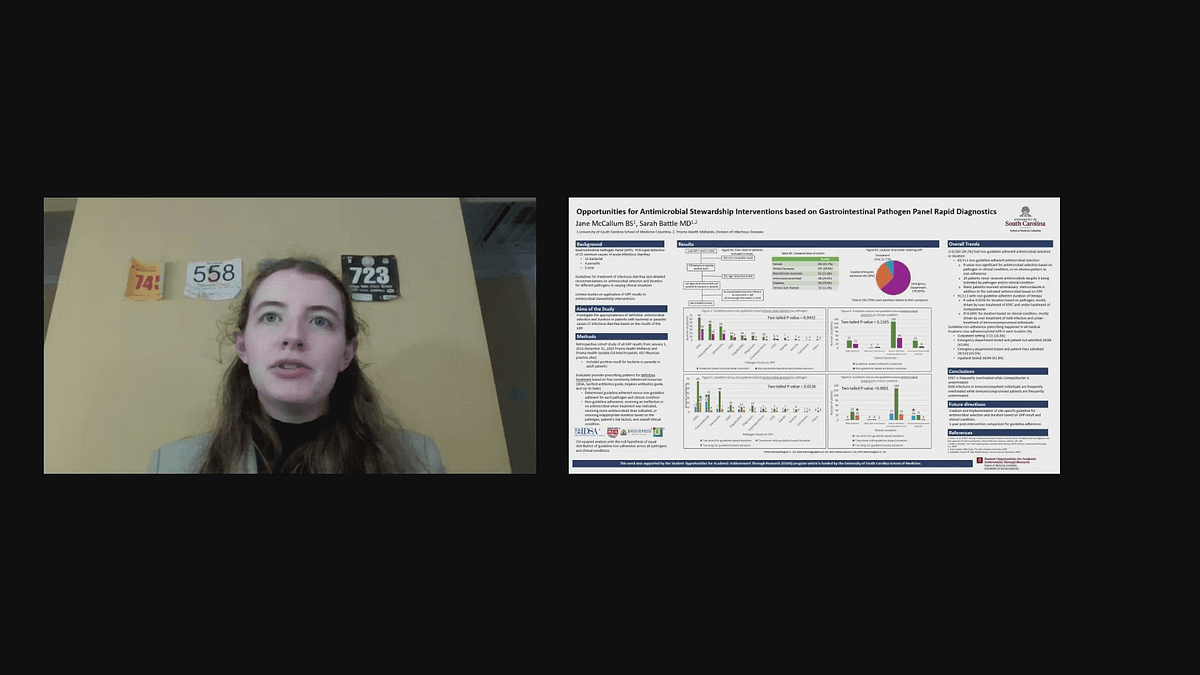
Introduction: With increases in antimicrobial resistance, stewardship is essential in antibiotic decisions. Infectious diarrhea is a common reason for antibiotic usage. The Gastrointestinal PCR Panel (GPP) is a rapid multiplex molecular test detecting common pathogens causes of infectious diarrhea. Unfortunately, current medical literature contains limited guidance on incorporating GPP results into stewardship decisions. This study investigates the appropriateness of antimicrobial selection in patients with bacterial or parasitic causes of infectious diarrhea.
Methods: We retrospectively analyzed all positive bacterial or parasitic GPP results from adults (≥18 years) in the Prisma Health Medical System in 2023, excluding patients with concurrent diagnosed infections. We assessed each patient for appropriateness of antimicrobial selection, including antibiotic choices, doses, and durations before and after GPP results. Inappropriate was defined as receiving an ineffective antibiotic, receiving more antibiotics than indicated, indicating but not prescribing treatment, and inappropriate duration of antimicrobial course based on the pathogen, patient’s risk factors, and overall clinical condition.
Results: Of 283 patients, 111 (39.2%) had an inappropriate antimicrobial selection or duration, 29 of which never received an effective antimicrobial despite being warranted. Of the 111, 91 (82.0%) received an inappropriate duration of therapy. Sixty-three patients (56.8%) had an inappropriate antibiotic selection with many receiving unneeded metronidazole. Inappropriate antimicrobial selection or duration occurred frequently in all medical settings: outpatient 7/21 (33.3%), emergency department not admitted 29/68 (42.6%), ED admitted 39/110 (35.5%), and inpatient 36/84 (42.8%). Nineteen of 54 immunocompromised patients (35.2%) received an insufficient duration of therapy. Immunocompromised individuals with Campylobacter (8/8, 100%) and Enteropathogenic E. coli EPEC (4/9, 44.4%) were frequently undertreated. Additionally, patients with Shigella and HIV frequently received an inappropriately short course (5/9, 55.5%). In contrast, immunocompetent individuals frequently received inappropriately long antibiotic courses to treat mild cases of Shigella (4/9, 44.4%), Campylobacter (4/10, 40%), EPEC (5/16, 31.3%), and Enteroaggregative E. coli (EAEC) (2/10, 20%).
Conclusion: Inappropriate antimicrobial therapy for infectious diarrhea was very common in all medical settings. Frequently immunocompromised patients were undertreated while mild infections in immunocompetent patients were overtreated. Many patients received multiple antibiotics when only one antibiotic was indicated.
Future studies:We plan to develop and implement a Prisma Health-specific GPP interpretation guideline to support stewardship via the Prisma Health Stewardship mobile application, with future studies evaluating its impact on prescribing patterns.