2025 AMA Research Challenge – Member Premier Access

October 22, 2025

Virtual only, United States

Would you like to see your presentation here, made available to a global audience of researchers?
Add your own presentation or have us affordably record your next conference.

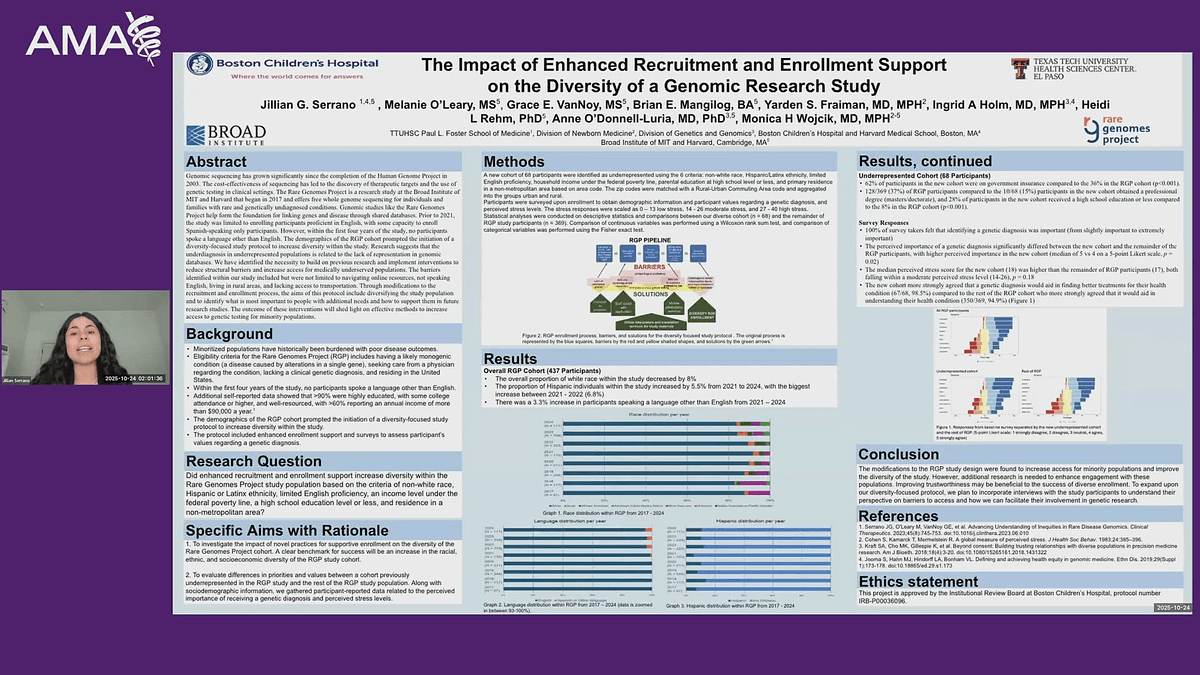
Background Despite advancements in genomic research, minoritized populations remain underrepresented, limiting the equitable distribution of benefits and contributing to ongoing health disparities. The Rare Genomes Project (RGP) at the Broad Institute of MIT and Harvard offers free whole genome sequencing to individuals in the U.S. with rare, suspected monogenic conditions who lack a genetic diagnosis. Between 2017 and 2021, enrollment was limited to English-proficient individuals. As a result, >90% of participants had some college education and >60% reported household incomes over $90,000, and no participants spoke a language other than English. Recognizing the lack of demographic diversity, RGP implemented a new diversity-focused study protocol in 2021 to address barriers to participation and increase access among historically underserved populations.

Methods To improve accessibility, RGP adopted strategies such as a simplified physician referral form, expanded language access (Spanish materials and interpreters), mobile phlebotomy, phone support, and extended staff hours. From 2021 to 2024, a total of 68 participants were enrolled who met at least one of six criteria for underrepresentation: non-white race, Hispanic/Latinx ethnicity, low income, limited English proficiency, rural residence, or lower educational attainment. Demographic and survey data were collected at baseline and sequencing was completed for all participants.

Results Post-implementation, RGP saw an 8% decrease in the total proportion of white participants and a 5.5% increase in Hispanic participants. The proportion of non-English speakers increased by 3.3%. However, rural enrollment declined after 2022, despite offering mobile phlebotomy and flexible contact hours. Of 437 total RGP participants, 68 comprised the new underrepresented cohort. This group was more likely to have lower education and income and greater use of government insurance (62% vs. 36%, p<0.001). At baseline, the underrepresented cohort reported higher perceived importance of a genetic diagnosis and slightly higher stress levels. While both groups agreed a diagnosis would aid understanding and preparation, the underrepresented group prioritized its role in identifying better treatments. Challenges such as limited internet or transportation and provider trust remained barriers for rural and minoritized communities.

Conclusion The revised RGP protocol showed some success in improving access and enrollment for underrepresented populations, especially through multilingual support and flexible engagement strategies. However, limited internet access and reduced rural participation highlighted remaining gaps. Patient-provider trust also emerged as a potential barrier. Future efforts will include participant interviews and follow-up surveys to better understand values and inform long-term engagement strategies. Continued enhancements and community-centered approaches are needed to ensure equitable access to genomic medicine.

Downloads

Transcript English (automatic)

Next from 2025 AMA Research Challenge – Member Premier Access

Seasonal and Avian (H5N1) Influenza Subtyping by a Multiplex Fragment Analysis Test

Seasonal and Avian (H5N1) Influenza Subtyping by a Multiplex Fragment Analysis Test

2025 AMA Research Challenge – Member Premier Access

Aloysus Lawong

22 October 2025

Stay up to date with the latest Underline news!

Select topic of interest (you can select more than one)

PRESENTATIONS

  • All Presentations
  • For Librarians
  • Resource Center
  • Free Trial
Underline Science, Inc.
1216 Broadway, 2nd Floor, New York, NY 10001, USA

© 2025 Underline - All rights reserved