2025 AMA Research Challenge – Member Premier Access

October 22, 2025

Virtual only, United States

Would you like to see your presentation here, made available to a global audience of researchers?
Add your own presentation or have us affordably record your next conference.

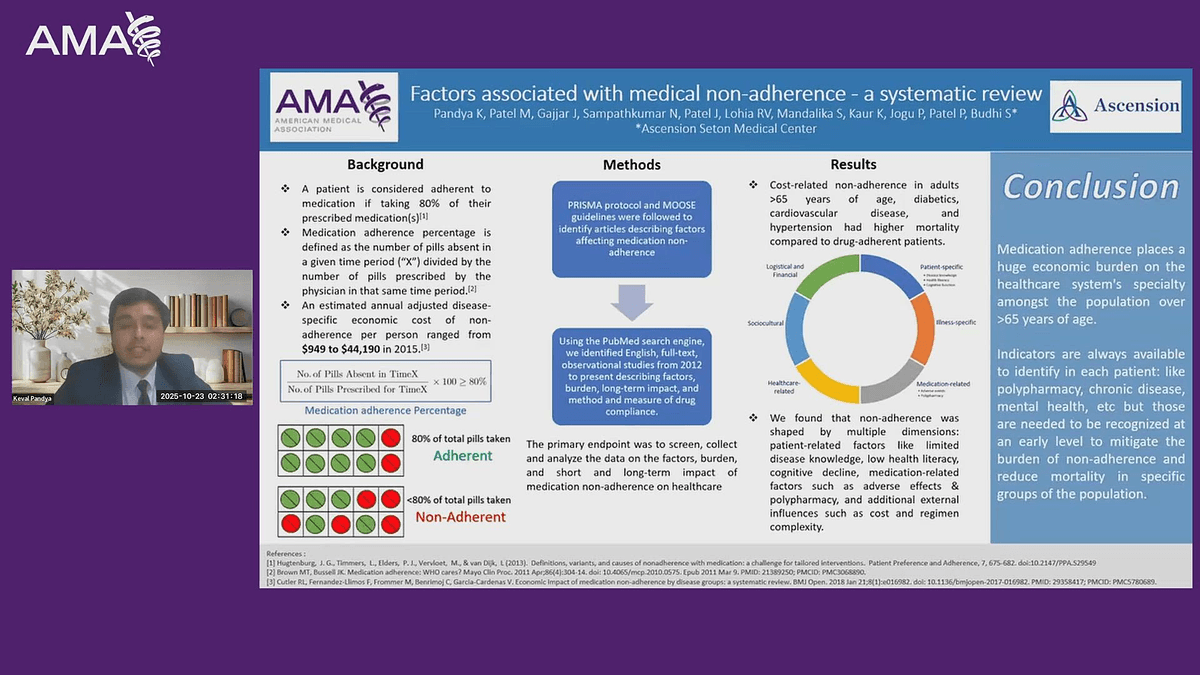
Background Medication adherence is a complex and interconnected issue. A patient is considered adherent to medication if taking 80% of their prescribed medication(s). Medication adherence places a huge economic burden on healthcare systems. An estimated annual adjusted disease-specific economic cost of non-adherence per person ranged from $949 to $44,190 in 2015.

Aim Our systematic review was to investigate factors affecting medication non-adherence in the adult US population (>18 years) from published literature in the last 10 years (2012-2023).

Methods We performed a systematic review using the PRISMA protocol and MOOSE guidelines to identify articles describing factors affecting medication non-adherence. Using the PubMed search engine, we identified English, full-text, observational studies from 2012 to the present using the following keywords: medication non-adherence, economic impact, factors associated with drug non-adherence, and cost-related medication nonadherence. The primary endpoint was to screen, collect and analyze the data on the factors, burden, and short and long-term impact of medication non-adherence on healthcare. We have also evaluated the methods of assessment and measures of adherence.

Results Of the initial pool of 982 studies describing information medication non-compliance, we found 10 full-length studies describing factors, burden, long-term impact, and method and measure of drug compliance. We found that cost-related non-adherence in adults >65 years of age, diabetics, cardiovascular disease, and hypertension had higher mortality compared to drug-adherent patients. The factors that contribute to medication compliance are broadly classified into patient-specific, illness-specific, medication-related, healthcare-related, sociocultural, as well as logistical and financial factors. A Systematic Review investigating cost and regimen complexity affecting medication Adherence in the elderly that included 9 studies identified patient-related factors such as disease-related knowledge, health literacy, and cognitive function, drug-related factors such as adverse effects and polypharmacy, and other factors.

Conclusion Medication adherence places a huge economic burden on the healthcare system's specialty amongst the population over >65 years of age. Indicators are always available to identify in each patient like polypharmacy, chronic disease, mental health, etc but those are needed to be recognized at an early level to mitigate the burden of non-adherence and reduce mortality in specific groups of the population.

Downloads

Transcript English (automatic)

Next from 2025 AMA Research Challenge – Member Premier Access

Software-Supported Remote Monitoring of Anti-Arrhythmic Drug Therapy in Atrial Fibrillation Patients: A Case Series

Software-Supported Remote Monitoring of Anti-Arrhythmic Drug Therapy in Atrial Fibrillation Patients: A Case Series

2025 AMA Research Challenge – Member Premier Access

Jagroop Doad

22 October 2025

Stay up to date with the latest Underline news!

Select topic of interest (you can select more than one)

PRESENTATIONS

  • All Presentations
  • For Librarians
  • Resource Center
  • Free Trial
Underline Science, Inc.
1216 Broadway, 2nd Floor, New York, NY 10001, USA

© 2025 Underline - All rights reserved