2025 AMA Research Challenge – Member Premier Access

October 22, 2025

Virtual only, United States

Would you like to see your presentation here, made available to a global audience of researchers?
Add your own presentation or have us affordably record your next conference.

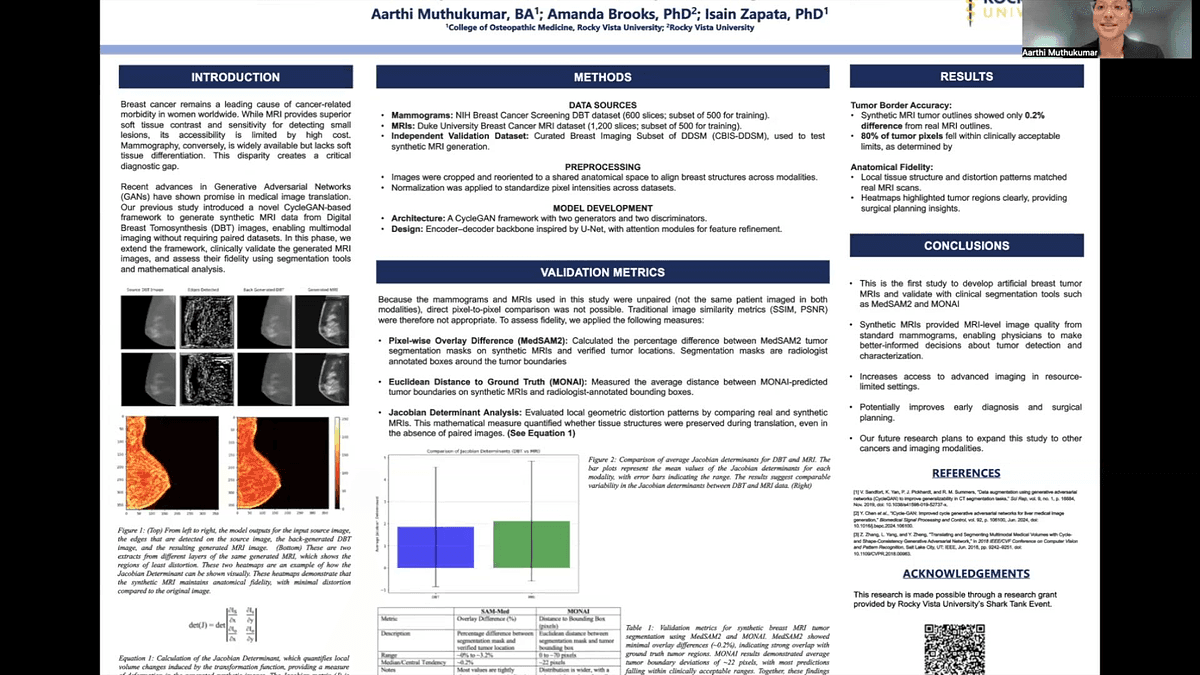
Breast cancer remains a leading cause of cancer-related morbidity in women worldwide, yet early detection through optimal imaging remains challenging for many patients. While MRI provides superior soft tissue contrast and sensitivity for detecting small lesions, its clinical utility is often limited by cost and accessibility. Conversely, mammography is widely accessible but offers limited soft tissue differentiation. Recent studies have demonstrated Generative Adversarial Networks’ (GANs) success in medical imaging translation, yet no prior work has validated synthetic breast MRI generation using clinical-grade segmentation tools. This disparity creates a critical gap where patients who could benefit from MRI-quality imaging cannot access it, potentially delaying diagnosis. To address this clinical challenge, our objective was to develop and clinically validate a CycleGAN framework for generating synthetic breast MRI from mammography. We developed a novel computational framework using CycleGAN-based deep learning to generate synthetic MRI data from standard mammograms. Our approach leverages the shared anatomical features between these modalities while accounting for their distinct imaging characteristics. We trained our model using 500 MRIs from the Duke Breast Cancer MRI dataset and 500 mammograms from the NIH Breast Cancer Screening DBT dataset. By utilizing unpaired image translation techniques, the model eliminates the need for pixel-matched multimodal datasets—a significant barrier in medical AI development. The synthetic MRI images underwent validation using two clinical-grade segmentation models: MedSAM2 and MONAI. Results demonstrated synthetic tumor regions showing only 0.2% average deviation from ground truth annotations (standard deviation 0.3%). Spatial alignment analysis revealed that 80% of predicted tumor pixels fell within clinically acceptable bounds of radiologist-annotated regions, with an average normalized distance of 7% from tumor boundaries. Additionally, Jacobian determinant analysis revealed comparable local deformation characteristics between synthetic and ground truth images (mean values: MG 1.86 ± 2.7, MRI 2.11 ± 2.7), confirming preservation of anatomical transformation fidelity. These findings suggest our synthetic MRI approach could democratize access to MRI-quality diagnostic information without the associated costs. The technology addresses the critical scarcity of paired multimodal imaging data while creating new possibilities for enhanced diagnostic workflows. By generating MRI-equivalent representations from readily available mammograms, this framework could particularly benefit underserved populations and resource-limited settings where MRI access remains prohibitive. Our computational approach represents a significant step toward bridging imaging modalities, not only in breast cancer diagnosis, but extrapolation to other diagnoses as well.

Downloads

Transcript English (automatic)

Next from 2025 AMA Research Challenge – Member Premier Access

ECG QTc Biomarkers Predict Adverse Events During Inpatient Dofetilide Drug Loading

ECG QTc Biomarkers Predict Adverse Events During Inpatient Dofetilide Drug Loading

2025 AMA Research Challenge – Member Premier Access

Douglas Corsi
Douglas Corsi

22 October 2025

Stay up to date with the latest Underline news!

Select topic of interest (you can select more than one)

PRESENTATIONS

  • All Presentations
  • For Librarians
  • Resource Center
  • Free Trial
Underline Science, Inc.
1216 Broadway, 2nd Floor, New York, NY 10001, USA

© 2025 Underline - All rights reserved