Would you like to see your presentation here, made available to a global audience of researchers?
Add your own presentation or have us affordably record your next conference.
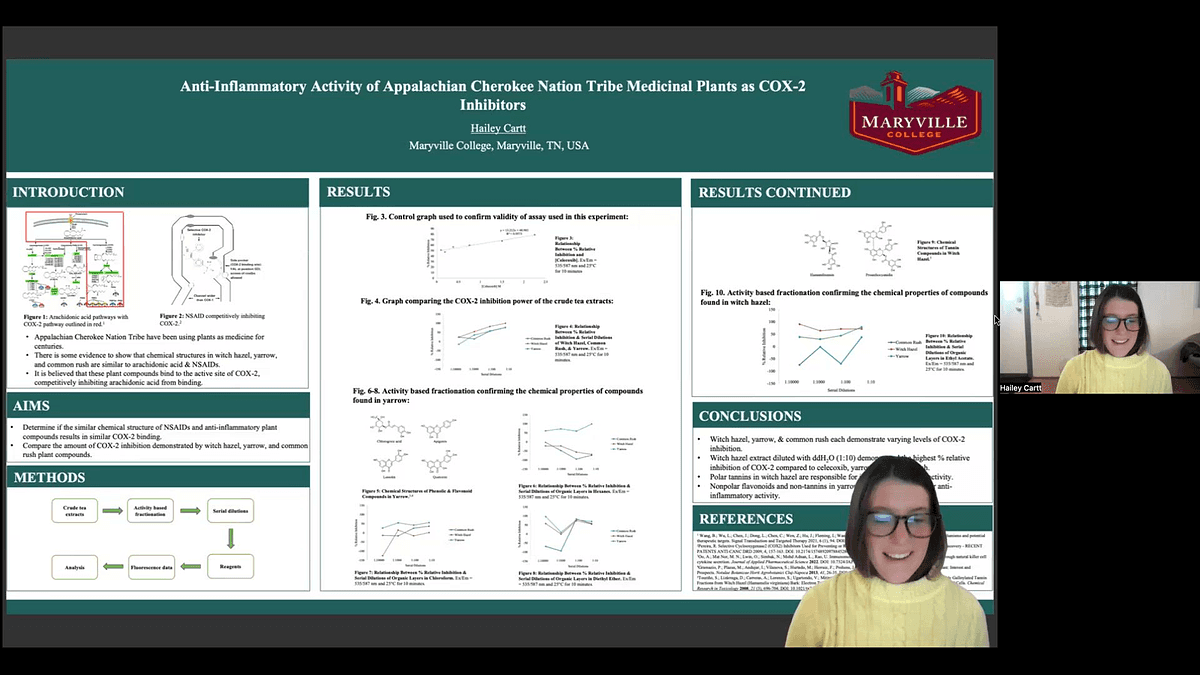
Background The use of plants as medicine is a tradition that has been around for centuries, dating back nearly 60,000 years. In the mountain regions of southern Appalachia, the Appalachian Cherokee Nation Tribe is known for their innovative use of witch hazel, yarrow, and common rush as anti-inflammatory treatments. Because of the effectiveness within this population, theories regarding the chemical components of these unique plants have abound. One theory suggests that the chemical structures of these plants are comparable to arachidonic acid, an important compound in the arachidonic acid pathway. In this pathway, arachidonic acid binds to cyclooxygenase-2, or COX-2, resulting in the release of prostaglandin 2 (PGG2). This ultimately leads to inflammation and its associated symptoms. When these anti-inflammatory plants are ingested, however, it is believed that the components bind to the active site of COX-2 instead, a strategy known as competitive inhibition. Therefore, the purpose of this study was to determine if these plants inhibit COX-2, a key enzyme responsible for inflammation.
Methods This goal was achieved by growing, collecting, and preparing witch hazel, yarrow, and common rush plant specimens. Following this, plant phenols were extracted using boiling water and activity-based fractionation. To test for COX-2 inhibition, the COX-2 Inhibitor Screening Kit (Fluorometric) was employed in conjunction with the SpectraMax M2 Plate Reader and SoftMax Pro Software application. Gas chromatology-mass spectrometry (GC-MS) was used to further identify biochemical compounds present in the samples. Data was inputted and analyzed via Excel using the percent relative inhibition equation outlined in the COX-2 Inhibitor Screening Kit (Fluorometric) instruction manual.
Results The results from this study found that a 1:10 dilution of witch hazel extract with double distilled water (ddH2O) has a percent relative inhibition of 100.31%, which is greater than a 2.25 M dose of celecoxib (78.96%). Compared to yarrow and common rush, witch hazel demonstrated approximately 30% greater inhibition of COX-2. Results from this study also confirm that there are flavonoids and non-tannin content present in yarrow and common rush, as well as tannins present in witch hazel.
Conclusion In conclusion, there is scientific basis to support witch hazel, yarrow, and common rush as COX-2 inhibitors. Not only does witch hazel appear to have greater anti-inflammatory properties than yarrow and common rush, but it also shows greater COX-2 inhibition than celecoxib in the laboratory setting. Moving forward, the anti-inflammatory activity of these plants could be compared to pharmaceuticals in clinical trials.