Would you like to see your presentation here, made available to a global audience of researchers?
Add your own presentation or have us affordably record your next conference.
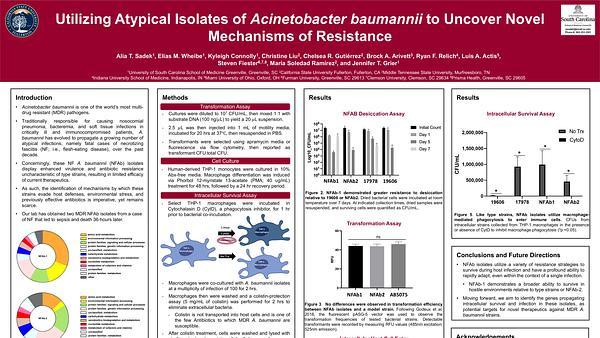
Background Acinetobacter baumannii is an opportunistic nosocomial pathogen of concern due to its increasing pan-drug resistance and growing recognition in its involvement in necrotizing fasciitis (NF), a severe soft tissue infection with high morbidity if left untreated. Some NF associated strains of A. baumannii (NFAb) exhibit an ability to survive within human macrophages. However, the macrophage response to intracellular infection by these strains is not well understood. Understanding the macrophage transcriptional response to NFAb infection may help us uncover new immune evasion mechanisms and inform future therapies.
Methods Human monocyte-derived THP-1 macrophages were infected with two NFAb strains (NFAb1 and NFAb2) or the reference strain ATCC 19606T at a MOI of 100. After 2 hours of infection and 2 hours of colistin protection assay, intracellular bacteria were quantified and total macrophage RNA was collected and subjected to RNA-sequencing (RNA-seq). Differential gene expression analysis was performed using the DESeq2 package in R and gene ontology analysis was used to evaluate enriched immune pathways.
Results RNA-seq identified distinct transcriptional signatures in response to infection with NFAb strains compared to the reference strain. Pro-inflammatory genes like TNF, CCL4 and IL1B were upregulated in response to NFAb infection, indicating heightened immune activation. Genes related to immune regulation and signaling like CX3CR1 and GPRIN3 were downregulated across all strains. This may indicate disruption of communication pathways. Genes involved in microtubule associated proteins and intracellular trafficking were upregulated as well, suggesting a role for macrophage phagocytosis in intracellular bacterial infection.
Conclusion This study sheds light on the transcriptional responses of human macrophages to A. baumannii infection, especially in the context of NF. Responses to NFAb strains were characterized by altered signaling regulation and increased inflammation, suggesting NFAb strains may survive intracellularly by triggering and modulating host immune pathways. Understanding of these mechanisms may provide us with novel targets for future therapeutic interventions against multidrug resistant A. baumannii infections.