Would you like to see your presentation here, made available to a global audience of researchers?
Add your own presentation or have us affordably record your next conference.
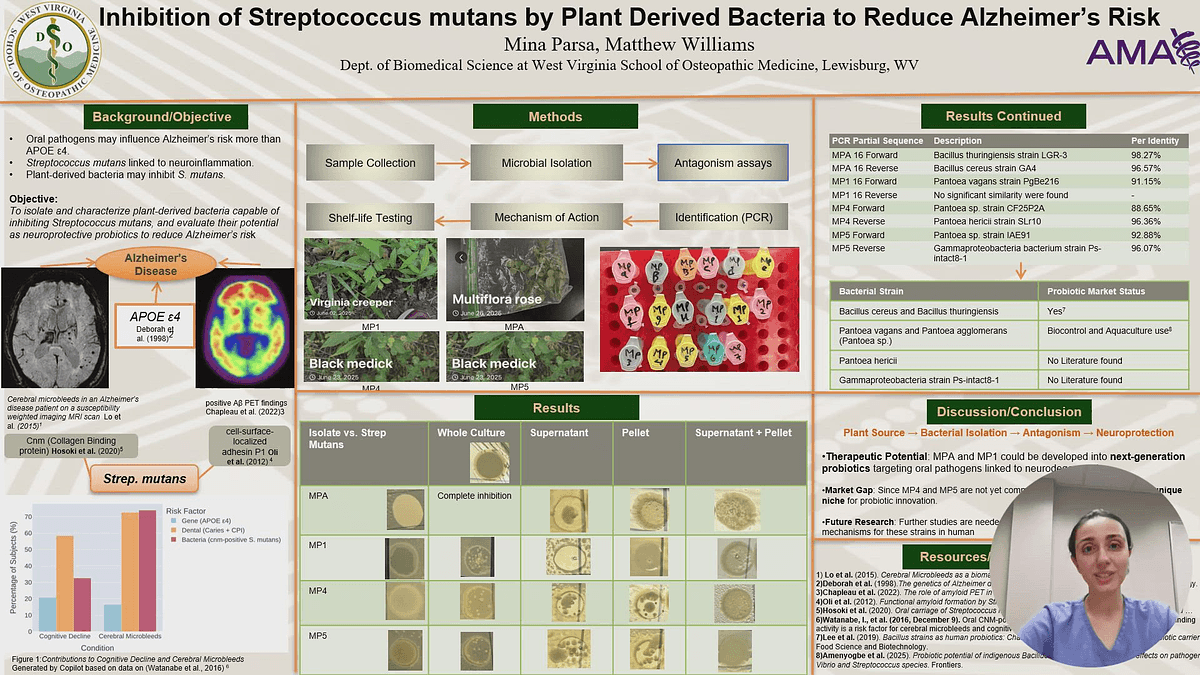
Background Alzheimer’s disease (AD) is a progressive neurodegenerative disorder characterized by cognitive decline, neuronal loss, and the accumulation of amyloid β plaques and tau neurofibrillary tangles. While genetic factors such as the APOE ε4 allele significantly increase the risk for AD, environmental influences are increasingly recognized as important contributors to disease pathogenesis. Among these, the oral microbiome has emerged as a potential modifiable risk factor. Streptococcus mutans, a primary etiologic agent of dental caries, has been implicated in cerebral microbleeds, an established risk factor for AD, through its expression of the collagen binding protein Cnm. This protein facilitates vascular adhesion and promotes the formation of bacterial functional amyloids, which may interfere with host amyloid pathways or compromise blood brain barrier (BBB) integrity. These mechanisms suggest a plausible link between S. mutans and AD-related pathogenesis. This study aimed to identify naturally occurring bacterial isolates from medicinal plants capable of inhibiting S. mutans, as a preliminary step toward developing biotherapeutic strategies for mitigating AD risk.
Methods Twenty-five medicinal plant samples were collected from various natural sites across WV. Microbial isolates were cultured on Brain Heart Infusion (BHI) and Tryptic Soy Agar (TSA) media, subcultured in Tryptic Soy Broth (TSB), and preserved in 50% glycerol stocks at −80°F. To assess antimicrobial activity, antagonism assays were performed by coculturing isolates with S. mutans. Additionally, headstart assays were conducted in which plant-derived isolates were allowed to establish for 24 hours prior to S. mutans introduction, enabling evaluation of competitive colonization. Isolates showing strong antagonistic effects were selected for identification using PCR amplification and sequencing of the 16S rRNA gene.
Results Out of 25 plant samples and 17 bacterial isolates, 10 demonstrated antagonistic activity against S. mutans. One isolate derived from Rosa multiflora exhibited the most potent inhibitory effect in both antagonism and headstart assays. This isolate significantly suppressed S. mutans growth, suggesting the production of antimicrobial compounds. Species level identification and further characterization are currently ongoing.
Conclusion This study highlights the potential of plant-associated bacterial communities as a natural source of microbial inhibitors targeting oral pathogens such as S. mutans. Given the emerging evidence linking S. mutans to AD pathogenesis, the discovery of such inhibitory bacteria may offer a novel biotherapeutic approach to reducing environmental risk factors for neurodegeneration. Future research will focus on evaluating potential application of this biotherapeutic approach in oral health and neuroprotection models aimed at decreasing AD prevalence.