Content not yet available
This lecture has no active video or poster.
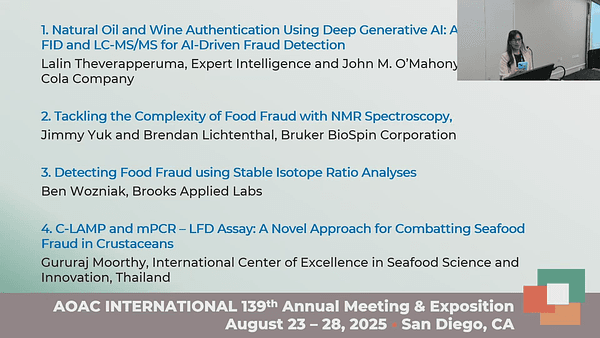
Food authentication is receiving increasing attention, as factors like supply chain disruptions and shifts in consumer purchasing habits continue to tempt bad actors to adulterate products for economic gain. Food fraud not only harms consumers, who may pay more for inferior quality products, but also producers, who face unfair competition from cheaper, adulterated products and risk reputational damage if their supply chains are compromised. Isotope ratio mass spectrometry (IRMS) is a technique that precisely measures small differences in the natural isotopic composition of light elements in a sample, providing valuable insights into a product's source and history. For example, plants have evolved different photosynthetic pathways that lead to variations in the carbon isotope ratios of their tissues; these differences can be used to detect adulteration of products like honey or coconut water with corn syrup or sugarcane. Similarly, the nitrogen isotopic composition of natural and synthetic fertilizers differs, allowing for the discrimination between conventionally- and organically-grown crops. Examples will be presented highlighting how IRMS may help verify the authenticity of raw ingredients and finished products, thereby protecting the integrity of the food supply chain.