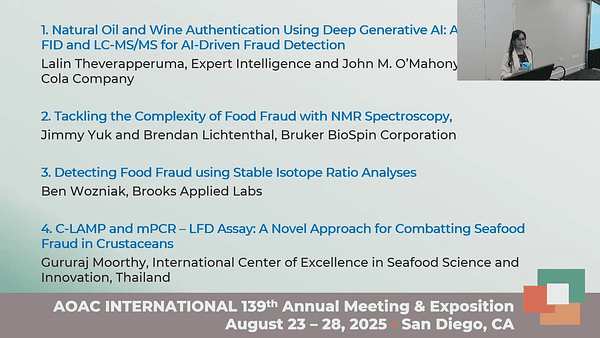
Food fraud threatens safety, industry integrity, and compliance. AI-driven GC-FID & LC-MS enhance detection, automating workflows for accurate, scalable, and reproducible fraud prevention in global supply chains. Traditional methods rely on pattern recognition and expert-driven analysis but struggle with co-elution, matrix interferences, and sample variability. AI overcomes these limitations by:
Learning authentic spectral patterns from minimal datasets, reducing reliance on extensive training data. Detects anomalies & fraud via AI-driven peak auditing and molecular profiling.Providing Explainable AI (XAI) insights, ensuring transparency, interpretability, and regulatory defensibility. AI-powered screening automates fraud detection, strengthens compliance, and standardizes authentication workflows across labs.
AI-Driven GC-FID Authentication: Ensuring Integrity in Natural Flavoring Oils Natural oils like lemon, lime, and vanilla face adulteration with synthetic esters and petrochemicals. GC-FID is effective but limited by co-elution and subjective interpretation. AI with Expert-Guided Learning improves detection by:
Identifying molecular adulterants such as synthetic esters, petrochemical-derived components, and non-compliant additives. Automating peak auditing, improving reproducibility. Learning from expert annotations, refining accuracy over time.
AI-Powered LC-MS Authentication: Detecting Counterfeit Wine The wine industry faces rising fraud risks, including mislabeling, dilution with lower-quality wines, and contamination. LC-MS provides molecular profiling for authentication but demands expert interpretation and manual data processing. AI-driven LC-MS revolutionizes wine fraud detection by:
Identifying unique chemical markers linked to grape varietals, fermentation conditions, and terroirs with small datasets Detecting fraudulent labeling, and distinguishing authentic vs. blended wines. Enhancing forensic analysis by detecting pesticide residues, smoke taint, and cork contamination (TCA).
Ensuring AOAC & Codex compliance, streamlining validation.