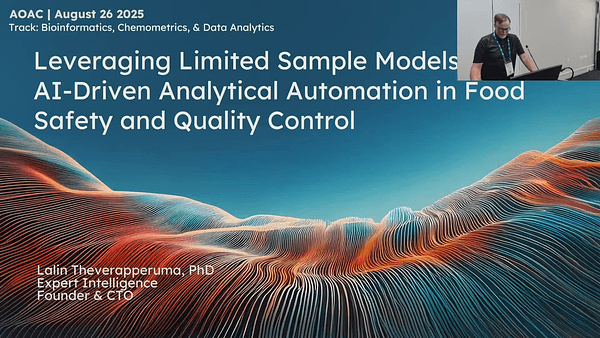
Ensuring food safety requires accurate, high-throughput analytical workflows to detect contaminants, verify authenticity, and monitor lipid quality. A novel Generative AI and Limited Sample Model (LSM) technology, automates untargeted high-resolution mass spectrometry (HRMS) analysis, significantly reducing data processing time and provides actionable insights in real-time. In a case study, LSM reduced lipid identification and result validation from two weeks to 20 minutes using a Vanquish Horizon HPLC system and a quadrupole-Orbitrap mass spectrometer. Covering a 200–2000 Da mass range at 120,000 FWHM resolution, it leveraged Diffusion AI to perform real-time analysis without predefined compound libraries. This enabled the discovery of unknown lipids with 99.8% accuracy in complex sample matrices. The system’s adaptive learning further identified novel compounds, marking a breakthrough in untargeted HRMS. This AI-driven workflow enhances food safety applications, including contaminant detection (oxidized lipids, industrial pollutants, pesticide residues), authenticity verification (vegetable oils, dairy, meat), nutritional labeling and quality control (fatty acid profiling, omega-3/6 balance), shelf-life and spoilage monitoring (lipid oxidation, rancidity prevention), food fraud detection (adulteration of high-value oils), and microbial/toxin analysis (lipid-based bacterial and fungal biomarkers). The demonstrated advanced AI-driven workflow ensures regulatory compliance, enhanced decision-making, and reduced manual processing. Generative AI and LSM empower laboratories to validate results efficiently, safeguarding food products while optimizing resource allocation and supply chain integrity.