FROMANNUAL REVIEWS

CogSci 2025

•

August 02, 2025

•

San Francisco, United States

keywords:

social cognition

eye tracking

psychology

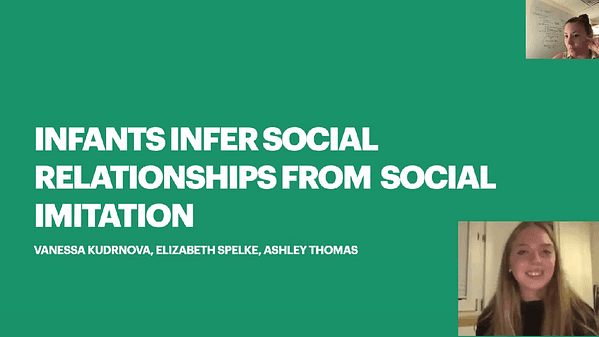
In their 2022 study, Thomas and colleagues found that when observing third-party interactions, infants, toddlers, and children might use saliva-sharing as a cue for inferring relationship thickness. The present study is the first external attempt to replicate their key findings with infants aged 8.5 to 10 months (n = 50). We used the original stimuli and the original design, but instead of running the study online and coding gaze direction manually from video recordings, we tested infants in a laboratory and measured gaze behavior with an eye tracker. Our study successfully replicated one of the main findings of the original study (longer looking at the saliva-sharing actress) while failing to replicate the other one (looking first at the saliva-sharer). These findings confirm that infants rely on certain behavioral cues for mapping social relationships among third-party individuals.

Downloads

PaperTranscript English (automatic)

Next from CogSci 2025

The Oscillatory Dynamics of Narrative Structure-Building
poster

The Oscillatory Dynamics of Narrative Structure-Building

CogSci 2025

Emily Coderre

02 August 2025

Similar lecture

Infants Infer Social Relationships between Individuals who Engage in Imitative Social Interactions
technical paper

Infants Infer Social Relationships between Individuals who Engage in Imitative Social Interactions

CogSci 2023

Elizabeth Spelke
Ashley J Thomas and 2 other authors

27 July 2023

Stay up to date with the latest Underline news!

Select topic of interest (you can select more than one)

PRESENTATIONS

  • All Presentations
  • For Librarians
  • Resource Center
  • Free Trial
Underline Science, Inc.
1216 Broadway, 2nd Floor, New York, NY 10001, USA

© 2026 Underline - All rights reserved

This site is protected by reCAPTCHA and the Google Privacy Policy and Terms of Service apply.