keywords:
predictive processing
semantics of language
language comprehension
eye tracking
psychology
language acquisition
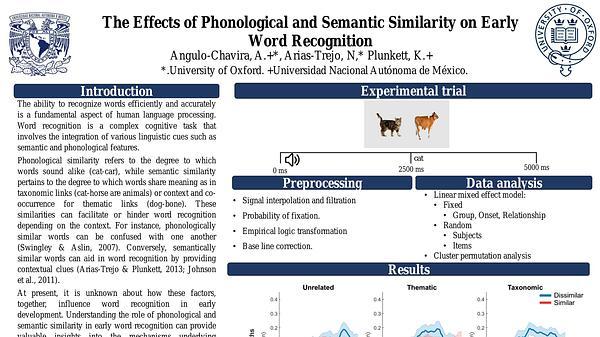
Grounded in predictive processing theory, this study explored the idea that young learners generate top-down expectations about upcoming words, both in meaning (semantic) and sound (phonological), to aid early language development. Researchers hypothesize that language acquisition is facilitated by children’s growing ability to anticipate not only the content of an utterance but also the specific forms those utterances might take. By examining how toddlers transition from broad conceptual understanding to accurate phonological prediction, this work sheds light on the cognitive mechanisms that enable rapid language growth possible in early childhood. The main goal was to determine when and how toddlers begin to form semantic and phonological expectations for upcoming words. To address this, three preferential looking experiments were conducted with Spanish-speaking toddlers at 18, 24, and 30 months. Highly constrained sentences were played aloud while toddlers viewed pairs of images: either a target or a competitor (semantic or phonological) and an unrelated distractor. As the toddlers listened, their gaze patterns revealed whether they anticipated the correct word or a related image before the target was fully pronounced. The rationale was that if toddlers can detect cues in the sentence and map them onto future words, they will show anticipatory looks toward images that match meaning or sound. Analyses revealed a progressive pattern: at 18 months, toddlers clearly predicted specific words in strongly constraining contexts, but showed no consistent anticipation of semantic alternatives. By 24 months, toddlers not only looked toward the correct referent but also demonstrated meaningful shifts toward pictures sharing semantic features with the target. This suggests they were extracting and forecasting aspects of meaning ahead of time. However, reliably predicting word forms based on phonological cues emerged more robustly at around 30 months, when children also shifted their gaze to phonologically similar items before the target was spoken. These findings highlight a developmental trajectory in which toddlers leverage broader conceptual knowledge first, refining phonological detail later as their linguistic system matures.