keywords:
group behaviour
social cognition
computational modeling
psychology
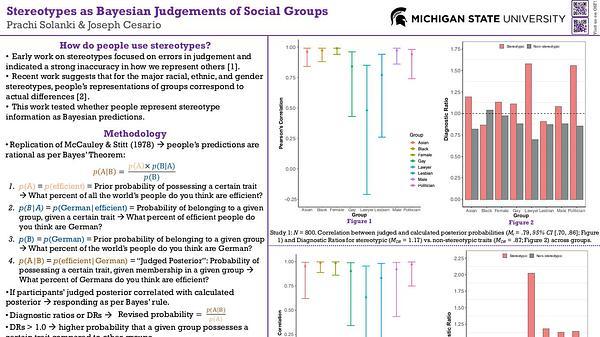
Do people’s stereotype judgements align with what Bayes’ Theorem dictates their judgements should be? Although prior work suggests they do, such research has generally been carried out with White undergraduates and minority social group stimuli (e.g., McCauley & Stitt, 1978; Solanki & Cesario, 2024). To determine whether these findings hold across diverse populations and stimuli, 870 Black American adults participated in a conceptual replication study that examined the congruence between stereotype judgements and a Bayesian criterion. Using trait and social group stimuli from prior research along with novel stimuli reflecting stereotypes about social groups such as White people and police officers, correlations between stereotype judgements and the Bayesian criterion were nearly half the size of those found in prior work (r = .34, vs. r = .64, Solanki & Cesario, 2024). An ongoing follow-up experiment designed to probe potential explanations is also discussed.