keywords:
human factors
decision making
psychology
survey
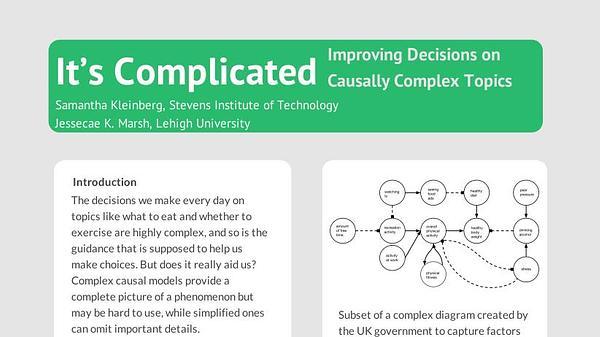
People use their knowledge to evaluate information and make decisions. Yet this knowledge may be faulty, like many lay beliefs on health remedies. This can lead to incorrect decisions and choosing ineffective interventions. While people often overestimate their knowledge, as shown in prior research, less is known about how metacognitive factors such as perceived versus actual knowledge interact with new information we receive during decision-making. Prior work has found that the simplest causal models are most helpful for everyday decisions, but did not examine the role of people’s existing knowledge. To address this gap, we conducted an online experiment to examine how metacognitive abilities influence decision-making with causal diagrams for Type 2 diabetes management. Actual knowledge positively predicted decision-making accuracy, while perceived knowledge had a negative effect, and simpler diagrams led to higher accuracy regardless of prior knowledge. We discuss the implications of our findings for designing decision support interventions.