FROMANNUAL REVIEWS

CogSci 2025

•

August 02, 2025

•

San Francisco, United States

keywords:

computer-based experiment

theory of mind

computational modeling

bayesian modeling

psychology

A child invents a game, describes its rules, and in an instant, we can play it, judge progress, and even suggest new variations. What mental representations enable such flexible reasoning? We build on recent work formalizing naturally expressed goals as a type of program, grounding linguistic descriptions into precise scoring systems. To support this notion, we study human-created objectives in a physics game environment. We leverage the formal representations to quantitatively analyze relationships between reward geometry, goal complexity, and perceived difficulty. We then propose a proof-of-concept of a computational goal inference method using these program representations and behavioral demonstrations, offering a concrete proposal of how humans reason about others' goals.

Downloads

Paper

Next from CogSci 2025

Modeling human learning and exploration in a temporal combinatorial bandit task
poster

Modeling human learning and exploration in a temporal combinatorial bandit task

CogSci 2025

+2
Guang-Yu Deng and 4 other authors

02 August 2025

Similar lecture

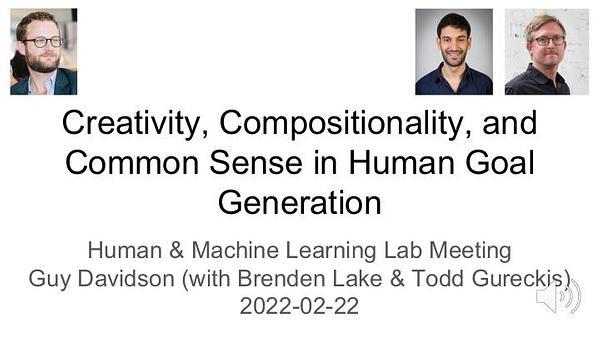
Creativity, Compositionality, and Common Sense in Human Goal Generation
poster

Creativity, Compositionality, and Common Sense in Human Goal Generation

CogSci 2022

Guy Davidson
Guy Davidson

30 July 2022

Stay up to date with the latest Underline news!

Select topic of interest (you can select more than one)

PRESENTATIONS

  • All Presentations
  • For Librarians
  • Resource Center
  • Free Trial
Underline Science, Inc.
1216 Broadway, 2nd Floor, New York, NY 10001, USA

© 2026 Underline - All rights reserved

This site is protected by reCAPTCHA and the Google Privacy Policy and Terms of Service apply.