FROMANNUAL REVIEWS

CogSci 2025

•

August 02, 2025

•

San Francisco, United States

keywords:

group behaviour

cognitive development

social cognition

psychology

Disagreements arise across many social situations, from families to teams to workplaces. This paper explores how children think about the strategies people use when they disagree with their groups. Specifically, we ask how egalitarian and hierarchical group dynamics influence whether children expect others to speak up about their disagreement, go along with disliked decisions, or leave their groups. We found that 6- to 8-year-olds hold a strong initial expectation that disagreers will speak up, despite believing that the kind of group they are in determines how effective it is to do so. These expectations were dynamic: when given evidence that speaking up did not work, children deferred to other strategies. These results suggest that children update their expectations based on both what has worked in the past and on group dynamics.

Downloads

Paper

Next from CogSci 2025

How Gesture Impacts Preschoolers’ Recall and Inference for Narrative Stories
poster

How Gesture Impacts Preschoolers’ Recall and Inference for Narrative Stories

CogSci 2025

Eliana Colunga
Chelsea Brown and 1 other author

02 August 2025

Similar lecture

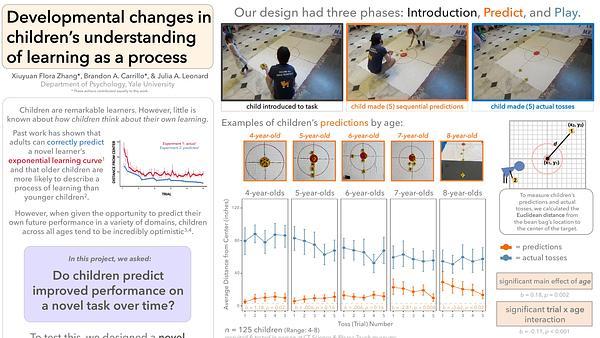
Children’s developing understanding of learning as improvement over time
poster

Children’s developing understanding of learning as improvement over time

CogSci 2023

Xiuyuan Zhang and 2 other authors

Stay up to date with the latest Underline news!

Select topic of interest (you can select more than one)

PRESENTATIONS

  • All Presentations
  • For Librarians
  • Resource Center
  • Free Trial
Underline Science, Inc.
1216 Broadway, 2nd Floor, New York, NY 10001, USA

© 2026 Underline - All rights reserved

This site is protected by reCAPTCHA and the Google Privacy Policy and Terms of Service apply.