keywords:
event cognition
embodied cognition
language comprehension
psychology
representation
Previous work suggests that non-visual object properties like
weight are automatically integrated into event models during
language comprehension. Horchak and Garrido (2021) found
that Portuguese speakers’ response times were faster when the
state of a presented object (e.g., a smashed tomato) matched
the event implied by the preceding sentence (e.g., You drop a
bowling ball on a tomato). In an exact replication in English
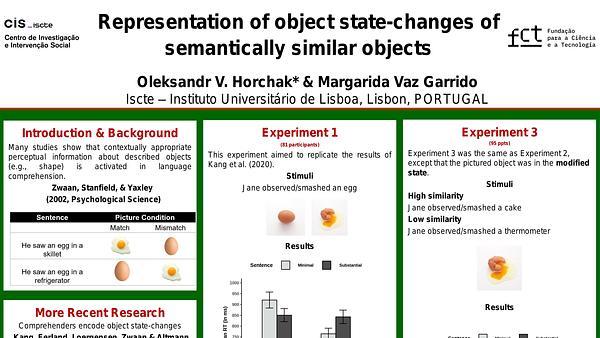
(Experiment 1), we failed to replicate this weight-state match
effect. In Experiment 2, we examined the potential role of
sentence focus, manipulating whether the target item served as
the subject or direct object in the sentence. Response times
revealed a weight-state match effect, but only when the target
object was the focus (i.e., subject) of the sentence. Overall,
these findings suggest that the representation of object state
changes during language comprehension may depend on the
interaction of object properties and language-specific syntactic
constraints.