keywords:
cognitive development
concepts and categories
learning
psychology
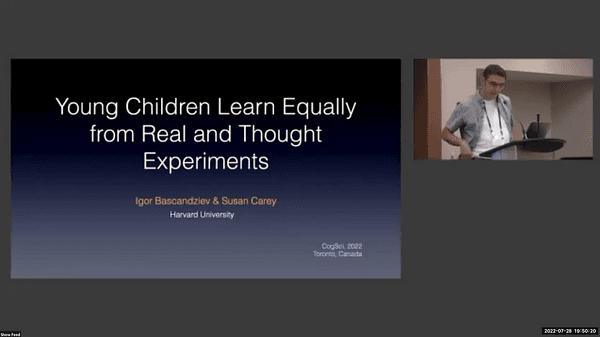
Thought experiments have been credited with generating new knowledge in the history of science. Although many parallels have been drawn between the thinking of scientists and children, it is not clear if children can generate new knowledge via thought experiments. We tested if the use of an extreme case thought experiment can help 6- to 9-year-olds to overcome the misconception that heavier rather than larger objects displace more water. A total of 70 children (MAge = 88.94 months) were assigned to a Control condition and to an Extreme Case condition designed to elicit children’s existing understanding of solidity, namely that two material objects cannot occupy the same space at the same time. Children received no feedback in either condition. We found that children in the Extreme Case condition performed better on both the Learning and Far Transfer trials, suggesting that thought experiments can serve as a learning tool in childhood.