FROMANNUAL REVIEWS

CogSci 2025

•

August 01, 2025

•

San Francisco, United States

keywords:

cognition of time

event cognition

concepts and categories

spatial cognition

psychology

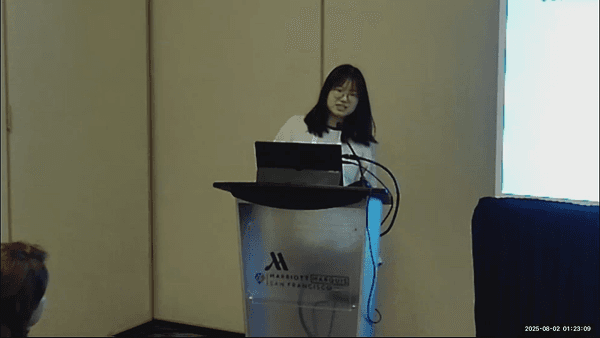
Humans use clocks to objectively measure their subjective temporal experiences. But can the spatial properties in a clock distort our experience of time ? This study examines how spatial boundaries in an analog clock influence prospective temporal judgements. We found that when the second hand crossed more boundaries, it distorted participants’ spatial memories, causing them to overestimate the arc traced by the second hand. However, this distortion in spatial memory did not significantly influence participants’ temporal judgments. Besides boundary crossing, our study examined and replicated the influence of speed on temporal judgment, with faster speeds of the second hand being associated with a dilated temporal experience.
Downloads

SlidesPaperTranscript English (automatic)

Next from CogSci 2025

Communication form modulates sentence interpretation: (A)typicality inferences from descriptions vs. direct speech
technical paper

Communication form modulates sentence interpretation: (A)typicality inferences from descriptions vs. direct speech

CogSci 2025

Elsi Kaiser
Muxuan He and 1 other author

01 August 2025

Similar lecture

ST-VLM: A Spatial-to-Image Multimodal Spatial-Temporal Prediction Framework with Vision-Language Model
poster

ST-VLM: A Spatial-to-Image Multimodal Spatial-Temporal Prediction Framework with Vision-Language Model

AAAI 2026

+4
Junping Du and 6 other authors

25 January 2026

Stay up to date with the latest Underline news!

Select topic of interest (you can select more than one)

PRESENTATIONS

  • All Presentations
  • For Librarians
  • Resource Center
  • Free Trial
Underline Science, Inc.
1216 Broadway, 2nd Floor, New York, NY 10001, USA

© 2026 Underline - All rights reserved

This site is protected by reCAPTCHA and the Google Privacy Policy and Terms of Service apply.